Family Hiking Backpacks: Comfort, Fit & Kid Gear
By Diego Nakamura • 7th Mar
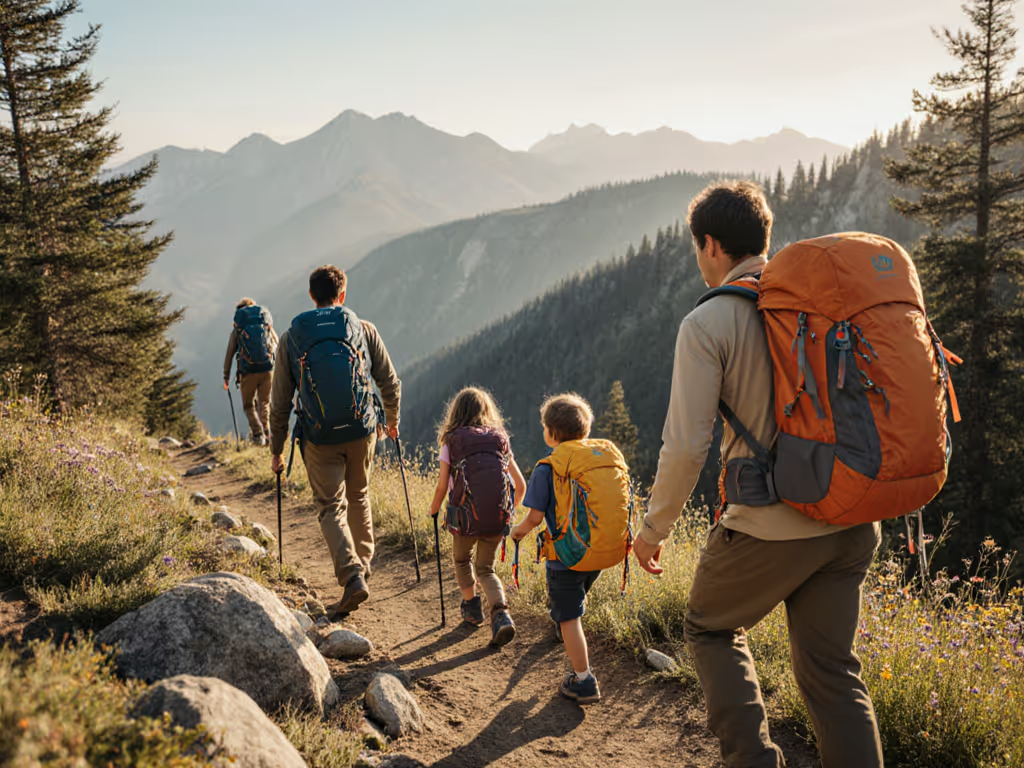
When you're hiking with kids, your hiking pack isn't just a convenience: it's the difference between a day your family wants to repeat and one you all dread. A pack that doesn't fit wastes energy, breeds resentment, and ends outdoor time early. But the right one, sized and loaded correctly for each person, keeps everyone moving, comfortable, and eager to book the next trip.
The core math for families is different than solo backpacking. You're distributing weight across multiple carriers (often one adult hauling most of the food, water, and shared gear), while kids carry lighter personal loads. Your pack needs to earn its keep across seasons, body types, and steadily changing kid sizes. This isn't the place to gamble on hype or a steep discount on a pack that'll send you to a chiropractor three miles in.
The Real Problem: Weight, Fit, and Honest Capacity
Family hiking loads are deceptively heavy. An adult managing dinner, a stove, fuel, shared shelter, and extra water for refueling small humans can hit 35-40 pounds over a weekend. Kids' packs that advertise 40 liters often max out usably at 25-30 pounds before the frame flexes and comfort collapses. The brands that acknowledge these limits, showing real tested carry weights and being honest about where performance drops, are the ones worth your time.
The second silent killer is fit. A pack rated for 65 liters sounds spacious until you actually load it at your trip weight. If the harness pulls too high on your shoulders or the hip belt rides across your ribs instead of your pelvic crest, you're not getting the advertised comfort. For families with mixed body types (different torso lengths, hip widths, and even shoulder angles), you can't buy one pack and expect it to work for everyone. You have to measure, test adjustability, and make realistic assumptions about who carries what. Use our torso length and hip sizing guide to get accurate measurements before you buy.
For kids, this compounds. A 10-year-old's torso is often in flux by 1-2 inches, and pack makers' youth sizing is inconsistent. The REI Tarn 40 and Osprey Ace 38 both market to kids, but the fit geometry differs enough that one might work and the other might sit too high or low. You need adjustability built in, not a one-size-fits-all frame.
Adult Packs: What Families Actually Need
If you're the primary load carrier, your pack has to sustain 35-40 pounds over terrain where your hands are free to steady a kid on rocks or manage microspikes in winter. This rules out ultralight packs that max out at 25 pounds. It also rules out 80-liter expedition packs that overpromise on comfort and waste weight in features you won't use on day trips or overnights.
The Osprey Atmos AG 65 and Aura AG 65 stand out here not because they're trendy, but because they carry real loads predictably. Tested data confirms they're comfortable with 45-50 pounds, and their unique harness rotates to follow your body's movement on slopes.[1] At $370 and under 4.8 pounds, you're paying for a pack that handles the job without costing an extra $200 in back pain over five years. The four harness sizes and adjustable suspension mean a 5'2" parent and a 6'2" one both fit the same model without crushing each other's necks.
Gregory's Baltoro 65 and Deuter's Aircontact Ultra 50+5 serve the same mission with different details. The Baltoro shines for very heavy loads and unforgiving terrain; the Aircontact Ultra wins on ventilation if you're hiking in humid climates or high heat. Both offer torso adjustability that actually works.[1] If you test each in person with a weighted pack, the comfort difference will be obvious. The price range ($350-420) reflects that you're buying a pack that won't obsolete after a season.
For families who prefer lighter adult loads (25-30 pounds), the Granite Gear Perimeter 50 at $250 and 3 pounds 3 ounces offers exceptional fit customization.[1] One reviewer loaded it past its rated capacity in Yosemite and found it stable, which signals real frame stiffness and smart load distribution. The modest weight and price make it a smart secondary pack if one adult takes the lead load and another takes a medium one.
Kids' Packs: Honest Capacity and Adjustable Fit
Kids under eight typically carry 5-10 pounds without strain; 8-12 year olds can manage 10-15 pounds on day hikes; teens can handle closer to adult loads. Any pack that ignores this is asking for postural stress and sore shoulders.
The REI Tarn 40 and Osprey Ace 38 (and the larger Ace 50 for teens) lead because they size down the adult geometry (adjustable torso, responsive hip belts, and honest weight limits), rather than shrinking everything proportionally.[4] A kid-sized pack should cost 30-40% less than an adult equivalent, not just weigh slightly less. The Osprey Ace 38 typically sits around $130-150; the REI Tarn 40 lands near $120-140. Both show clear care in load distribution and ventilation for active kids who sweat. For model-by-model advice, see our kids hiking backpacks fit and safety comparison.
The Gregory Wander 50 Youth and Deuter Fox 40 follow similar logic: modular sizing, real testing, and no marketing overreach about ultralight specs kids don't need.[4] The Fox 30 variant works well for younger grade schoolers; the Fox 40 bridges into early teen years.
For families with budget constraints, the ULA Spark (youth ultralight) runs around $140-160 and keeps pack weight below 1.5 pounds, meaning a kid carrying 15 pounds feels like they're carrying 16.5 instead of 17-18.[4] Trade-off: durability is lighter, and the pack sacrifices pockets and frame stiffness. Fine for a season or two of summer day hikes; risky if you expect it to absorb three years of family trail time.
The Hidden Variables: Water, Organization, and Shared Gear
Family packs live or die on specific features. Your pack must answer: Where do water bottles sit? Can a kid reach them without taking the pack off? Are pockets on the hip belt wide enough for a snack, a hand warmer, or a sun stick?
Child water storage solutions matter most. Adult packs often have bottle pockets too high or too deep for small hands; kids' packs often lack proper attachment for bladders. The Osprey Ace and Gregory Wander both feature accessible side pockets and competent hydration compatibility.[1][4] The Tarn 40 includes excellent organization: front zipper access, a removable lid pocket for keys or snacks, and trekking pole loops that kids can actually use.[4]
Family-friendly backpack features include removable or stored hipbelts (useful if the pack transitions from a kid to a gear bag later), external gear loops for sleeping pads or trekking poles, and compression straps that work at partial loads without creating floppy gaps.[1][4] These details cost almost nothing to add, but add enormous flexibility across trips and years.
Child safety attachment systems like sternum straps with reliable adjustment and chest carry loops let you attach a small pack to an adult's pack frame in emergencies (steep terrain, fatigue, altitude adjustment). The Osprey and Gregory models both feature adjustable sternum straps that don't pinch.[1][4]
Fit Testing and the Return Reality
You cannot accurately test a pack in a store with 10 pounds of sand. Real comfort emerges at your trip weight, on your terrain, over four to six hours. That's why return policies matter: brands that allow 30-day returns (Osprey, REI, Gregory, Deuter) reduce the risk of a $300 mistake. If a pack feels off after mile two on the trail, you need a path to change your mind.
Here's the math that usually wins: buy the pack that fits well at the local outfitter, even if it costs $50 more than online. Add the avoided shipping, restocking stress, and false start to the equation. A pack that works from day one is worth the premium.
Durability and the Comfort-Hours Equation
In my gear library years, I watched families choose one well-made pack over two budget alternatives. The budget packs had loose seams in year two and zipper failures by year three. The good pack? Still in rotation five years later, rebooked most weekends, with a new hip belt installed at cost and kept going. That's the comfort-hours difference: one pack might deliver 300 comfortable family hours; two cheaper ones might deliver 150 before they're unusable.
When comparing packs, look for these signals of durability: 1000-denier base fabrics (stated or visible), reinforced stress points, welded seams on load-bearing edges, and serviceable frame components (not glued together). If you're unsure what those materials mean, our backpack fabric science guide decodes denier ratings, ripstop, and coatings. Osprey, Gregory, and Deuter all publish care details and sell replacement parts (hip belts, straps, zipper sliders). That means your $350 pack isn't trash at year four; it's fixable.[1][4]
What Families Often Overlook
Most reviews test packs solo, in optimal conditions, for a day or two. Real family hiking adds variables: one adult pulling weight while managing a child's pace and morale, mixed loads and improvisations, temperature swings across seasons. A pack that feels like a dream at 20 pounds might feel unstable at 38 pounds on a side-hill. Understand safe backpack weight limits so you don't overload a frame or a growing hiker. This is why torso adjustability and frame stiffness matter so much: they don't lie about capacity.
Also consider the pack's second life. Will it become a travel daypack when your kid outgrows the 40-liter kid model? Will it serve as an emergency backup pack, or a gear hauler for car camping? Osprey and Gregory packs resell well because they're recognizable, repairable, and valued in secondhand markets. That $370 Atmos AG 65 might have $250 of residual value in three years if you buy thoughtfully.[6]
Summary and Final Verdict
Family hiking packs succeed when they're honest about weight capacity, adjustable enough to fit diverse bodies, and durable enough to absorb multiple seasons and resizes. The best aren't always the flashiest or the cheapest. They're the ones that let your family focus on the trail, the views, and each other, not on shoulder bite, hip bruising, or whether the pack will collapse in year two.
For the primary load carrier: The Osprey Atmos AG 65 or Gregory Baltoro 65 is the pay once, cry once choice. Both carry 40+ pounds predictably, adjust to different body types, and hold their value. Budget $350-420 and expect a decade of use.[1]
For kids aged 6-11: The REI Tarn 40 or Osprey Ace 38 offer true adjustability and realistic weight limits at $120-150. Expect 3-5 years of use before a torso-growth replacement is needed.[4]
For teens and mixed-load scenarios: The Osprey Ace 50 or Gregory Wander 50 Youth scale into adolescence, and both accept heavier loads as kids mature.[4] They're worth the $150-180 investment because they don't obsolete fast.
For backup or budget: The Granite Gear Perimeter 50 at $250 is a genuine value for a secondary adult pack or a first investment while you dial in your family's needs.[1] Durability is solid; resale is reliable.
The core insight: your family will book out more weekends if everyone's pack fits well and stays comfortable. An uncomfortable pack doesn't save money; it kills trips, triggers replacements, and costs you time on trails. Choose once, choose carefully, and watch your family's outdoor calendar fill up.
Related Articles